Posts

The Eternal journey of Voyagers into the Space

Image
If you have seen Interstellar, chances are really high that you must have liked it. But have you ever paused and focused on the word Interstellar itself? It means travelling between two or more different star systems. Our solar system is also a star system. In Interstellar, Cooper travels through a wormhole and reaches another star system. In other words, he travelled interstellar. Yes, it was just a movie. Umm not just a movie for me personally but nvm. But here is the part that still blows my mind. Humans have actually made two real spacecraft that travelled interstellar for real. Not CGI, not fiction, not theory. Two tiny machines built by human hands have left the Sun behind and are now drifting in the emptiness between the stars. I genuinely envy them. Meet Voyager 1 and Voyager 2 The two silent explorers who left home in 1977 and never returned. NASA launched Voyager 2 first on August 20, 1977 Then launched Voyager 1 on September 5, 1977 Yes, Voyager 2 was launched e...

Black Holes- Wonders of Universe

Image
Exploring the black holes What is a Black Hole? A black is a mysterious place in the cosmos where laws of physics do not work. It is a type of place where even light cannot escape due to a very strong gravitational pull. Its existence took place when the core of a supermassive star collapse after which a supernova explosion took place. FORMATION OF A BLACK HOLE To understand the formation of a black hole we need to understand the concept of a star. Nuclear fusion is the process through which a star produces its energy. A star is made up of mostly hydrogen and helium. In its core, nuclear fusion occurs in which hydrogen combines with hydrogen to produce helium. This process continues further and forms more heavy elements like carbon, silicon, magnesium, deuterium, etc. Iron is also formed in the core which can be referred to as the murderer of the star. The problem with iron is that it does not further react to form elements. As a result when the amount ...

Stellar Classification of Stars

Image
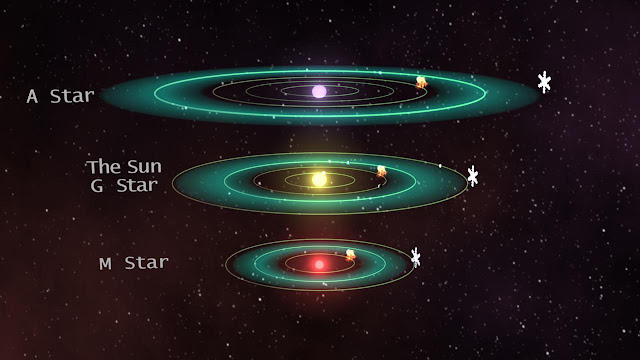
Empire of Stars It has been a long time that we are exploring the universe through modern telescopes to find other worlds where we can find other civilizations. Till now there are no accurate pieces of information we can find about the alien worlds but during these we have found about many new planets and new types of stars. In this post, we will discuss the different types of stars on the basis of stellar classification. What is Stellar Classification? It is a method to classify stars on the basis of their  spectral  characteristic.  A stellar spectrum can reveal many properties of stars, such as their chemical composition, temperature, density, mass, distance, luminosity,    On the basis of this classification stars are divided into 7 parts. 1. O type Stars Color- Blue or White Temperature- More than 30000 Kelvin Stars of this type are very rare, but because they are very bright they can be seen at great distances and four of the 90 mos...

A Tour to Our Milky Way

Image
Complete exploration of Milky Way In the night all the stars that we see in the sky are part of one galaxy known as the milky way . In the night sky it was imagined that milky way contains all the stars in the universe but with the help of advanced telescopes we get to know that milky way is just one of the galaxy among billions of galaxies. The stars are arranged in a pinwheel pattern with four major arms, and we live in one of them, about two-thirds of the way outward from the center.  Most of the stars in our galaxy are thought to host their own families of planets. Quick Review about the milky way . Type of  Milky Way Galaxy- Spiral Galaxy . Confirmed Exoplanets-  4414 Planets . Confirmed Planetary Systems- 3074 Systems What is at the Center of the Milky Way? All of the stars in the Milky Way orbit a supermassive black hole named Seggiterius A at the galaxy's center, which is estimated to be four million times as massive as our Sun. Fo...

Our Sun- Boon today, destructer tomorrow?

Image
Let's Explore The Sun For the past 4.53 billion years, the Sun has been shining in the sky brightly. But there is famous saying that everything which is born in this universe is bound to die someday. This same fact also implies our sun which will also die one day. The death of the sun will be so massive that it will vanish humanity from the earth. So let's start with basic information. Basic Facts Our Sun is a spherical ball of plasma which is located at a distance of 149.55 million Km from Earth. Our sun is a yellow dwarf but the main fact is that the real color of the sun is white due to the scattering by the atmosphere it seems to be yellow in color.   According to scientists, The sun will keep shinning for the next 5 billion years but its adverse effects on earth will start after 1 billion years where the energy received by the earth from the sun will increase by about 10%. It is very hard to imagine that the sun which is currently providing energy to the e...

Mars- The next Place for Humanity

Image
MARS - OUR NEXT HOME In This Blog, we will study The red planet in Detail. It involves the following Topics 1. Quick Facts 2. Structure 3. Atmosphere 4. Borealis Impact 5. Life on Mars 1. Quick Facts Length of one day on Mars is 24 Hrs 37Min Length of one Year is 687 earth days The Sky Colour of Mars is Dark Yellowish Brown(Butterscotch) The temperature of Mars is -87 Degree F The Gravity On Mars is 3.7m/s square which is 0.375 on earth The highest atmospheric density on Mars is found 35 km above the earth's surface. Mars is named after the Roman God Of War Due to its red color which resembles blood. Mars has the biggest mountain of the solar system Olympus Mons and the largest crater of the solar system Hellas Planitia Mars have two small moons Phobos and Deimos 2. Structure Like Earth, Mars also have Molten Core, Mantle, and Crust. The Core of Mars is metallic consisting of nickel and iron and a small amount of sulfur. The Core is partially...

Our Companion- The Moon

Image
Our Major Partner - Moon Introduction - Our moon is the brightest object in the night sky. It is a natural satellite of earth revolving around it since the time it was formed. It has a very big contribution to make life possible and comfortable on earth. It is a dependent body on which earth depends but it is not a part of star constellations. Formation Many theories are stating how the moon became the natural satellite of the earth. We will discuss them one by one. 1. Capture Theory - This theory states that the Moon was a celestial body which by chance entered the solar system from outside. While crossing the Earth's orbit the gravity of earth influenced the moon and got tidally locked with the moon. But the fact which goes against this theory was that Moon was not so small than the Earth and thus the earth couldn't capture the moon as its gravity is n't strong enough to capture the moon. As a result, this theory was rejected. 2. Fission Theory ...